
| Key Indicator | Recommended Level and Standard |
|---|---|
| Total Daily Feed Intake | Equivalent to 3% to 4.5% of live lamb weight (dry matter basis) |
| Initial Fattening Ratio (Adaptation Phase) | 60% forage and 40% concentrate |
| Final Fattening Ratio (Finishing Phase) | 15% forage and 85% concentrate |
| Dietary Crude Protein | Approximately 12% to 15% (depending on age and growth stage) |
| Standard Fattening Period Length | 90 to 100 days targeting maximum feed conversion efficiency |
The fattening period is one of the most critical management phases in the livestock industry, where the primary objective is defined as achieving the maximum daily weight gain in the shortest possible time, typically around 90 to 100 days. Success in this process depends on a precise understanding of ruminant digestive physiology and scientific ration formulation, as approximately 60% to 70% of a livestock farm’s operating costs are allocated to feed supply. Optimizing the feed conversion ratio (FCR)—the ratio of feed consumed to live weight gain—is the key factor in the economic profitability of fattening operations.
Imbalanced nutrition not only reduces livestock growth rates but can also lead to severe metabolic disorders such as rumen acidosis, bloat, and urinary calculi. To achieve the maximum genetic growth potential in lambs, a precise balance must be established between highly digestible carbohydrates, effective fiber, amino acids, and trace minerals. In the following sections, we will explore the scientific principles of calculating daily feed intake and the feeding stages for fattening lambs.
How much feed does a fattening lamb need per day?
On average, a fattening lamb must consume daily dry matter intake (DMI) equivalent to 3% to 4.5% of its live body weight. For a 35 kg lamb, this translates to 1.2 to 1.6 kg of total feed (combined forage and concentrate) per day. This amount changes in proportion to the animal’s weight gain, age, and ambient temperature, and the ration must be formulated to provide the energy and protein required for rapid skeletal and muscular development.
To better understand this calculation, veterinary nutritional formulas operate based on the animal’s live weight. For instance, if your fattening lamb weighs 40 kg, its daily dry matter intake will be approximately 1.4 to 1.8 kg. As the animal ages and approaches the end of the fattening period, its feed intake increases, but the feed efficiency (or feed conversion ratio) gradually declines. This means the animal will require more feed to produce each kilogram of meat.
“Optimizing dry matter intake and establishing a precise balance between rumen-degradable energy and bypass protein are the foundation for improving the feed conversion ratio and promoting gastrointestinal health in small ruminants.”
Dr. Peter Van Soest, Journal of Animal Science
How to adjust the forage-to-concentrate ratio during the fattening period?
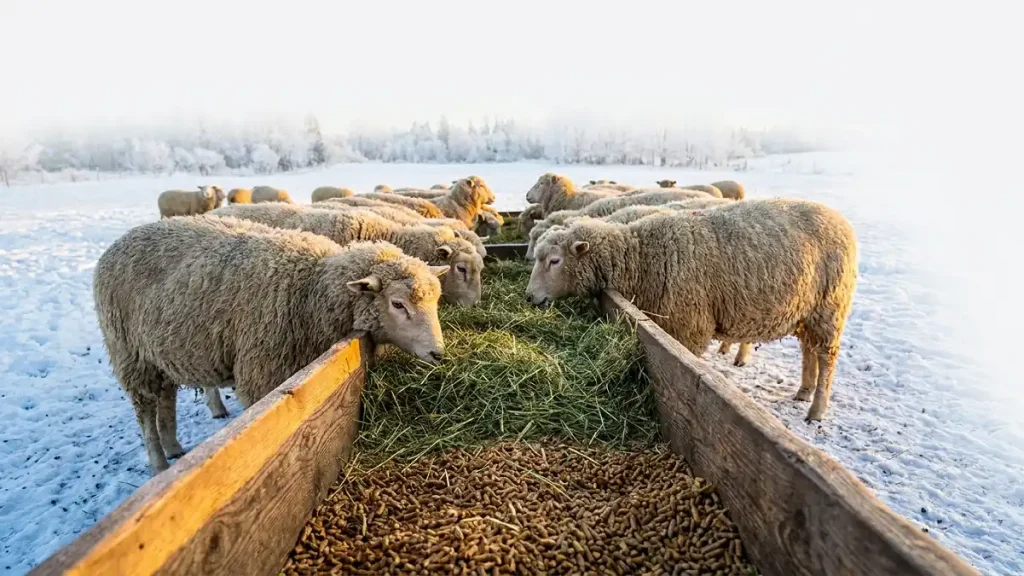
Gradually changing the forage-to-concentrate ratio is the secret to successful fattening, as the animal’s digestive system requires time for the rumen microbial population to adapt to digesting high amounts of starch. The use of grains such as barley and feed corn as primary starch sources, and soybean or rapeseed meal as primary protein sources, must be carefully managed.
| Fattening Phase | Forage Share (% of diet) | Concentrate Share (% of diet) | Primary Physiological Goal |
|---|---|---|---|
| Initial (Adaptation) | 50% to 60% | 40% to 50% | Rumen bacterial adaptation and prevention of acidosis |
| Middle (Rapid Growth) | 30% | 70% | Bone growth and muscle tissue development |
| Final (Finishing) | 10% to 15% | 85% to 90% | Completing intramuscular fat and maximizing final weight gain |
What are the stages of feeding a fattening lamb from day one to the end of the period?
Feeding a fattening lamb consists of three critical phases: adaptation, rapid growth, and finishing, each requiring distinct management in ration composition. Failing to respect these stages and abruptly introducing high-energy feed can result in heavy losses.
In the first stage, known as the adaptation period, which covers the first 14 days of fattening, the animals transition from their natural environment or pasture to the feedlot. During this phase, the bulk of the ration consists of high-quality forage like dry alfalfa, and the concentrate amount is added daily in very small increments (e.g., 50 to 100 grams per day) to prevent shocking the gastrointestinal microbial population. In the second stage, or the rapid growth period, dietary crude protein must be adjusted to its highest level (around 14% to 15%) to maximize skeletal and muscular growth using high-quality protein sources like soybean meal. Finally, in the finishing phase, which accounts for the last 20 days of fattening, the protein level is reduced to 12% to 13%, and the share of high-energy grains like corn and feed barley is increased to develop intramuscular fat and improve carcass quality.
Why do water management and feed additives affect weight gain?
Water, as the most critical nutrient, has a direct impact on dry feed consumption, such that any restriction in access to clean, palatable water immediately results in decreased appetite and reduced growth. Across different seasons, the temperature of the water consumed by the livestock must be monitored to maintain their willingness to drink.
In addition to water, the use of specialized additives plays a significant role in improving digestive efficiency. Toxin binders protect the animal’s liver by absorbing fungal toxins present in forage and grains. Probiotics help stabilize the beneficial bacterial population in the rumen, and ionophores alter fermentation pathways to increase propionic acid production, thereby improving digestion and maximizing the efficiency of energy utilization in the animal’s body.
Frequently Asked Questions
What is the best weight to start the lamb fattening period?
The most suitable weight to start fattening is after weaning, at around 25 to 30 kg, because at this age, skeletal and muscular growth rates are at their physiological peak, yielding the best feed conversion ratio.
Can dry bread be used as a primary energy source to replace barley?
No, dry bread significantly increases the risk of toxicity, severe acidosis, and rumen stasis due to its high salt content, potential presence of hazardous mold toxins, and highly gelatinized starch. It should never serve as the base of the ration.
Is the use of urea permitted in the ration of fattening lambs?
Using urea as a non-protein nitrogen (NPN) source is not recommended for young fattening lambs under 30 kg, as their rumen is not yet fully developed. For larger animals, its inclusion must be highly limited, gradual, and supervised by a nutritionist to prevent ammonia toxicity.
How many days does the standard lamb fattening period last?
The standard fattening period usually lasts between 90 and 100 days. After this timeframe, muscular growth slows down, and the animal begins depositing excess fat, which is unprofitable from both an economic and marketability standpoint.
What is the primary cause of diarrhea in fattening lambs after increasing concentrate levels?
The primary cause of this condition is rumen acidosis, which occurs due to an abrupt change in the diet or an excessively high starch-to-effective-fiber ratio. This acidifies the rumen environment, destroys beneficial bacteria, and damages the intestinal mucosa.
Conclusion
Determining the exact daily feed intake for fattening lambs and adjusting the forage-to-concentrate ratio is the core of scientific fattening management. A successful feeding program must be designed based on the animal’s live weight calculation, high-quality forage, and a balanced concentrate. Adhering to the two-week adaptation period, ensuring a constant supply of safe water, and incorporating mineral supplements and permitted additives will guarantee the animal’s digestive health and prevent the loss of farmers’ capital.
If you are looking to purchase pellet feed, concentrates, or specialized supplements for fattening lambs to improve feed conversion and daily weight gain in your herd, choosing standard and high-quality products is a fundamental step in boosting your farm’s productivity. For professional consultation on ration formulation and sourcing premium inputs, you can contact our experts to select the best options tailored to your herd’s needs.
Scientific References
- National Research Council (NRC), Nutrient Requirements of Small Ruminants: Sheep, Goats, Cervids, and New World Camelids, National Academies Press
- Journal of Animal Science, Energy and Protein Requirements of Fattening Lambs
- Small Ruminant Research Journal, Effects of Concentrate to Forage Ratio on Lamb Performance and Carcass Characteristics
- Sheep & Goat Medicine, D. G. Pugh, metabolic and nutritional diseases section